

By Raisa Rahim, PhD
“How come we’re like this, like we’re buried alive? Either the germs eat us up or the sun burns us. Always some kind of sickness. And every day we work and work. For what? Poor dad, always working so hard. I think he was born working …. All the time feeding the Earth …. only to one day, just like that, get struck down by the sun. And there you are, helpless… Tell me, why must we live here like this? What have we done to deserve this? You are so good and yet you have to suffer so much …. Why us, burrowed in the dirt like animals with no hope for anything?”
A son, watching his father suffer from heatstroke after working in the fields. Excerpt from “ … y no se lo tragó la tierra/ … And the earth did not devour him” by Tomás Rivera
Narratives like these highlight how food systems are built upon the backs of laborers subjected to incredibly strenuous conditions so that the rest of us have the luxury of exerting ourselves merely by picking up a bushel of oranges from a bin at a grocery store.
California’s fertile environment and temperate climate have supported Native Californians in nourishing themselves while supporting the land, with its uniquely rich plant and animal biodiversity since time immemorial. This productive environment has buoyed a more-than-$60billion-dollar agricultural industry that feeds the world but also fuels climate change and negative community-level impacts through greenhouse gas emitting machinery, unsustainable livestock-managing practices, discriminatory air and water pollution emissions, and other methods with undesirable impacts.
Where much progress has been made to address these and other challenges through state- and community-sponsored initiatives to adapt the industry to less extractive methods via programs like the California Air Resources Board’s Funding Agricultural Replacement Measures for Emission Reductions (FARMER) Program and the California Department of Food and Agriculture’s Healthy Soils Program, the industry (and society as a whole) often fails to recognize how integral immigrant farmers1 and farm workers2 are to the entire food system.
While the entire agricultural industry is struggling amid ever-shrinking profit margins, the climate crisis is disproportionately multiplying the pressures on socioeconomically vulnerable groups. Global climate change has been impacting California in particular by increasing the frequency of ecosystem disasters like wildfire, droughts, and floods; this wide variety of problems calls for a wide variety of solutions and perspectives, highlighting the need for a diversity of people to be at the table to develop and apply effective strategies.
Our country is facing an unprecedented assault on many immigrant communities by this Federal Administration’s Immigration and Customs Enforcement (ICE) who are a foundational part of our society, though they are often treated as expendable labor. So why care about climate change in the future when there are more immediate crises facing these communities right now? For one, climate change is already harming many of these same communities in the present day; addressing one reverberates strongly to the other.
The most immigrants (here defined as being either of first- or subsequent-generations since arriving) in the country live in California, whether they are authorized or not (Immigration Research Initiative, 2025). California is an agricultural powerhouse fueling the nation, producing more than a third of the country’s high-value commodity fruits and vegetables. Climate change poses a major threat that puts the industry, and the people making it function, in a perpetually precarious position through significant crop losses, more frequent heat-related illnesses for vulnerable groups, as well as several other wide-ranging impacts.
Read on to understand how these factors are connected and what we can do to safeguard what we value to build a diverse, resilient world.
~
Who makes up California’s agricultural workforce and how is the industry structured around them?
To contend with the agricultural industry’s constant personnel needs, the federal government established the H-2A visa program in the 1960s to employ foreign, temporary laborers when U.S.-based workers were not sufficient to fill gaps in the workforce. The program requires that employers must provide housing and transportation to workers at no cost to them, with wages at or exceeding minimum wage so as not to adversely impact domestic workers’ pay minimums.
As of a July 2025 report, 2.5 million farm workers are employed each year nationwide (where 2 million were foreign-origin and 500,000 were U.S.-born). Of the foreign-origin farm workers, an estimated 850,000 were authorized U.S. immigrants or naturalized U.S. citizens, 850,000 were unauthorized, and 300,000 were authorized H-2A guest workers (UC Davis Gifford Center for Population Studies, 2025).
Between a third and a half of all farmworkers in the U.S. work in California to produce our labor-intensive crops and commodities. “About 90 percent of California’s seasonal hired workers were born in Mexico, and half of these Mexican-born workers are unauthorized” (UC Davis Gifford Center for Population Studies, 2025). The top three counties of Kern, Monterey, and Fresno hiring these workers reflect the cultivation and harvesting needs of these counties’ major, labor-intensive crops (e.g., strawberries, grapes, and tangerines).
Though the origins of unauthorized farmworkers are often unclear on a systemic level, a recent study surmised that the top three Mexican states where the H-2A workers stem from are Guanajuato (climate: temperate; major crop: alfalfa), Michoacán de Ocampo (temperate/ tropical; avocados), and Puebla (mild/ moderate; corn). While there is diversity of microclimates across these regions, they hold some similarities to those of California in climate and crop characteristics.
Farmers and farmworkers from these and other regions thus bring valuable intergenerational knowledge on agricultural best practices from their homeland, where many of their traditional ecological knowledge bases serve as templates for current climate-smart practices that farmers are returning to. For example, in the drought-stricken regions of Fresno County, farmers are adopting the milpa farming system developed in the country that is now Mexico for diversely productive water-conserving agriculture (Figure 1).
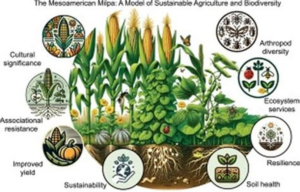
Figure 1: The milpa system of integrated agriculture combines several mutually beneficial practices to build farming system resilience. Image Credit: AgriTech Insights.
Using average temperature as a very crude approximating indicator of environmental conditions3, past and projected climates of the top three California agriculture counties (Kern, Monterey, and Fresno) and the top three Mexican states that H-2A workers likely currently originate from (Guanajuato, Michoacán, and Puebla) can be compared to provide valuable initial insights on how migration and climate conditions interact (Figures 2A and 2B). While many other factors determine agricultural productivity like soil fertility, pest pressure, and countless others, the high connectivity between these factors may still be indicative of trends in the system as a whole.
Some takeaways (Figure 2C) are that Mexico’s climate of the late 20th and early 21st centuries will likely resemble California’s climate at the end of this century. Mexico’s future climate will require separate analyses to contend with the more extreme climate changes. Within this narrow lens, it might be presumed that farm workers and farmers who have been doing agricultural work since then hold transferrable knowledge of how to farm in those projected future conditions, should they get access to land, equitable resources for continued land tenure, etc., that they can pass on to future generations.
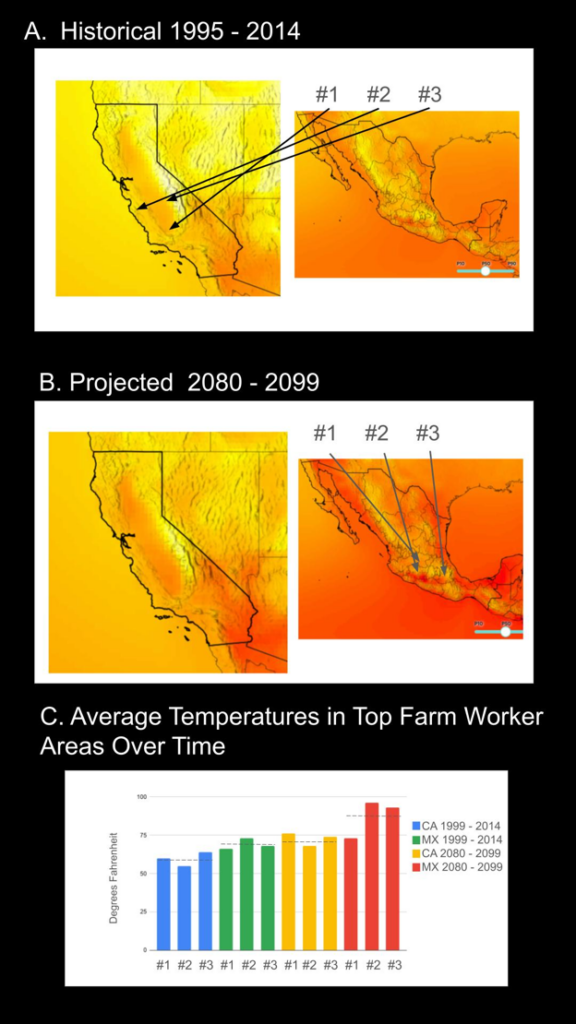
Figure 2: A comparison of observed mean surface air temperatures from 1995 to 2014 in the Mexican states that most H-2A workers originate from and the top three agriculture counties in California with predicted temperatures in 2080 to 2099 in the same regions (using a “high carbon” scenario, SSP5-8.5). Dashed lines show average temperature in each region over a given time period. Climate scenario maps adapted from the Climate Change Knowledge Portal.
The 17th U.S. Department of Agriculture National Agricultural Worker Survey gathered employment and demographic data on workers who were not H-2A visa recipients. While there is seasonal fluctuation in labor needs, these workers worked an average of 43 hours a week. Though it is difficult to track the average hours a week worked by unauthorized workers, they are still eligible to receive the overtime pay guaranteed for agricultural workers.
Where the federal border patrol has almost completely blocked unauthorized farm workers from entering the country, the Administration has simultaneously made recent amendments to the H-2A program to increase the number of H-2A workers and reduce these workers’ wages amid the workforce shortage caused by the immigration raids.
This presumably would allow employers in the United States to hire more workers to make up for the shortfall caused by current ICE activity, except that the program requires employers to pay for basic amenities like housing, so reducing workers’ money-in-hand would still be offset by the need to accommodate more people. This may foreshadow that employers may cut corners in this respect.
So what is the job like?
“It’s easy but hard at the same time … Anyone can do it. It’s just that no one really wants to.”
一 “The Consequences” by Manual Muñoz, Chapter 1: Anyone Can Do it
Farm hands’ work conditions are grueling. Workers may leave home before dawn and not return until late night, be it rain or shine. Looking across the State’s many climate zones, temperatures range from 32 to 110 degrees Fahrenheit across the year. While California only has guidelines for the maximum temperature (80 degrees) for outdoor workers before requiring the use of safety precautions, it is widely known that working outdoors for long periods of time in either extreme is not healthy. The work is so laborious, sweat drips down to blur workers’ vision, making workplace accidents more likely. California’s Occupational Safety and Health Appeals Board in 2023 held that employers must provide workers with easily accessible water, though implementation has not been uniform.
Conventional agricultural work has major implications for the people supporting it; though the work often does not include a minimum educational requirement (Figure 3), making the work widely accessible, workers are often vulnerable to various occupational health hazards that makes agriculture the one of the most dangerous industries in the country. Their work often requires stooping and repetitive motions leading to muscular and skeletal issues like carpal tunnel syndrome. Depending on the crop being harvested, the farm equipment4 used and the speed of picking poses additional variables that could lead to workplace injuries (i.e. a sprained ankle from stepping off a ladder, crushed fingers while using harvesting tools, etc.). Depending on topography, workers may work in conditions with poor air circulation that can lead to confusion and other cognitive difficulties. People may vomit, faint, or even have seizures from heatstroke.
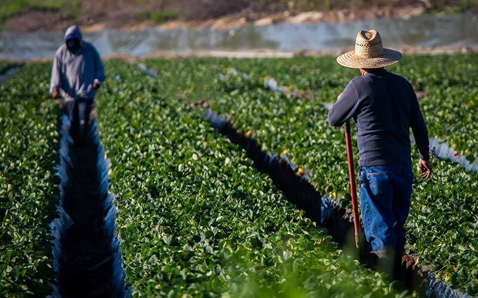
Figure 3: Farmworkers in Southern California are now eligible to gain a High School Equivalency degree to “‘[foster] social mobility and [promote] a more inclusive society’”. Image Credit: CSU Fullerton.
Depending on the practices used on the farm, workers are directly and indirectly exposed to a variety of pesticides and fertilizers that can have lasting respiratory, reproductive, and neurological effects. Pesticide exposure has had disproportionate effects on vulnerable groups of agricultural workers and the communities they reside in. The Department of Pesticide Regulation’s enforcement-supporting initiatives are coming online to more tightly regulate these substances (though possibly not quickly or comprehensively enough to avoid community harms).
The work does not only take a physical toll; heavy pressure put on farm working parents is felt deeply across generations as well. Without the funds for child support, farm working couples are forced to either leave their kids to sit in the car while their parents work5 or leave them home alone. In either case, these children do not receive the enrichment they need to develop on par with their highly supported peers, potentially contributing to the persistent racial achievement gap among California’s K through 12 students.
Amid all of these challenges though, a universal truth remains: parents do not want to worry their children about how precarious their situation is. Since many farmworker jobs are temporary, their annual income leaves them just below the poverty line even if their hourly rate exceeds minimum wage rate requirements. Given their meager wages, the cost of living is incredibly high, keeping the workers on a perpetual hamster wheel. Where workers pay rent to their employer or private landlords, they face eviction if they cannot pay by the monthly deadline; this is especially difficult when farm hands are picked up by ICE, as their families are forced to make up the difference without their primary income earner. Farm hands (ranging from pre-teen to the 70s and even pregnant people) work the fields, with no means to make retirement plans while they barely have the funds to cover their immediate needs.
ICE is thought among workers to raid farms at the end of the week so farmers do not have to pay for the week’s labor, while workers are deported to their country of origin in fear for their lives. Immigration vans can be seen prowling the fields and the orchards, while planes can be heard rumbling overhead; this constant threat of monitoring creates such a deep sense of unease that even workers with official documentation find little comfort since enforcement mistrusts their authenticity.
White it is unclear whether the recent ICE activity has targeted farmers of color to the same extent as farm workers, racial profiling has been strongly alleged but legally upheld. BIPOC farmers also face disproportionate, significant barriers to entry and to running thriving operations. In addition to the land tenure and discriminatory lending obstacles previously mentioned, there are challenges in language access and cultural inclusion, direct and indirect exclusion from specialized certification and the markets they cater to, and other restrictive factors.
While the Native peoples were the first stewards of the land we now call California, White Californians have been the majority land owners for the past several generations. “For years, farmers of color have been subject to discriminatory practices in agriculture … in the early 19th and 20th centuries, [like] receiving less in government loans compared to their White counterparts” (California Farmer Justice Collaborative).
“Agricultural land reform is an urgent and necessary step toward creating a just food system that centers rural economies and biological diversity, as well as addresses the historical land theft, exploitation, discriminatory policies, and systemic racism faced by Black, Indigenous, and People of Color (BIPOC)” (Community Alliance with Family Farms, 2025).
Various Federal and State initiatives are supporting a growing number of racially diverse farmers gaining access to agricultural land, though the current Federal Administration has sunsetted many equity-building funding programs. Recalibration in government action towards community needs increases access to culturally relevant food, spurs growth in local economies, and makes significant contributions to climate change mitigation through techniques like increasing food distribution efficiencies, as well as on-farm carbon sequestration6 and water efficiency.
The work is tough but if anyone can do it, will everyone do it?
Inspecting the myth that immigrants take American jobs, many investigators report that farmers have long-reported that they have trouble recruiting and retaining local workers.
Evidence shows that many factors contribute to domestic workers dropping out of the agricultural labor force. Given how physically taxing the job is, American farmhands regularly quit within hours of the first day. Besides the job difficulty discussed above, domestic laborers are thought to avoid farm work because they 1) feel social stigma from participating in “low status” jobs, 2) feel that their energy output outweighs the benefits compared to other opportunities open to them, and 3) the temporary nature of the seasonal job does not afford stability, among other reasons.
Employers cite that even when domestic workers were paid above minimum wage, they were still not drawn to this profession for the long-term. Though almost a third of agricultural workers are considered U.S.-based, the fact that the H-2A program is necessary in the first place is a huge indicator that the U.S.-based workforce does not meet the personnel needs of the industry. So it is categorically not true that immigrants are taking American jobs because Americans are not willing to consistently and reliably do these jobs at the numbers that the industry requires. The Pew Research Center has repeatedly found that the majority of Americans agree with this fact.
One possible stopgap solution is through agritourism, providing the public with pay-to-pick opportunities. This gave farmers a much-needed additional income stream, however meager, when national or global events decimate crop prices. But while urban residents enjoy the seasonal activity, it is an unreliable business model for profit-seeking farmers; unpredictable weather makes agritourists’ help sporadic and their inexperienced hands may potentially damage plants and/ or produce. This scheme may work for some well-established farms, but it is a less viable option to rely on for those who are on shakier ground (Vittek, 2023).
So immigrants are a vital part of the agricultural industry’s labor force and food production… How else do they support food security in California?
Immigrants’ generational ties are a boon for society at large. Even if migrants come with skills that limit their employment prospects to low wage jobs, the upward mobility of their children invigorates communities. As these second-generation immigrants build stability, they start to build generational wealth to further break down systemic barriers ingrained in today’s infrastructures (though this access is not equally in reach).
Immigrants run almost half of the small businesses in California, though access is being restricted at the Federal level according to immigration status. They are responsible for 17% of the national GDP, despite making up about 14% of the population (United Ways of California 2025). But aside from the monetary contributions that immigrants make to our state’s economy, they form cultural hubs that ground the diverse Californian experience. In addition to service jobs like dishwashing and cooking, they are highly successful restaurant owners who merge food and advocacy.
Food banks are critical connection points between the farming industry and underserved communities. Immigrant communities are often beneficiaries of food banks; so when federal cuts disrupt this partnership and destabilizes community food security, there are rippling effects. It makes access to food harder for more than 15% of Californians, limiting their spending power. It harms children and adults’ physical and mental health. It adds uncertainty to farmers’ already precarious operation plans and financial security. It stymies climate change mitigation goals. There is even evidence that restricting food access may increase the likelihood of civil unrest and conflict.
The importance of these centers as community-building focal points is apparent. Karen Strach, a Food Access Programs Manager at Sacramento Food Bank & Family Services, describes how food banks serve people in need of assistance while fostering a mutual aid environment:
“While we don’t have quantitative data to measure [how immigrants benefit from and contribute to public resources] directly, my experience is that community members who have previously relied on food assistance are often among the most generous in giving back. We see this in small but meaningful ways at distributions—such as individuals sharing extra supplies (like bags when participants are required to bring their own) or setting aside items at client-choice distributions for families they feel may need them more. Beyond that, many former beneficiaries return as volunteers or become financial donors, motivated by their personal understanding of how impactful a smile or a helping hand can be during difficult times.”
Where high import is placed on pro-social “traditional family values” (i.e., caring for one another, having a strong work ethic, etc.) in many Californian immigrants’ countries of origin, importing these values can enrich our communities and food systems in many ways.
~~
So a very important question follows: what are the immediate and long lasting effects of current federal activity? Beyond the cruelty of this hostile style of immigration enforcement, what does it mean for California’s – and by extension, the country’s – food security?
The Federal Administration’s policies and actions have had major impacts on California’s agriculture industry. From wasting more than 2 billion gallons of water slated for farms, to forcibly deporting and detaining countless immigrants, to terrorizing immigrant communities deeply intertwined with the agricultural sector, major repercussions will likely be felt for decades to come.
Starting with a short-term view, what have been the immediate effects of these aggressive actions? The crackdown on immigration may have reduced the agricultural workforce by 20 to 40 percent. A 2025 report projected that mass deportation efforts would cost the state more than $275 billion in California’s GDP output from undocumented workers’ missed work (due to either fear-based absenteeism or deportation). Los Angeles alone lost between an estimated $0.84 billion and $2.51 billion in productivity, wages, and sales, depending on the scale and duration of immigration enforcement.
A 2025 study projected that ICE raids alone would raise food prices by 5 to 12% in California due to crop production losses. Though some predict that prices will not jump significantly since labor accounts for only a portion of produce costs, any increase puts additional pressure on communities already struggling with high food prices. Likewise, there have been mixed disruptive effects in the short term nationwide, but are predicted to have negative effects on food prices in the long-term (Factually, 2026). In addition to the debilitating federal tariffs, crop losses from a lack of workers will likely damage California’s international exports’ robust revenue stream.
Between March and July of 2025, the agricultural workforce fell 7% (155,000 workers) nationwide; the number of H-2A visas issued increased, but not enough to offset the sharp decrease in available workers that hit year-round sectors of the industry especially hard (Pyne, 2025). And without enough farm hands, crops are rotting all over the state; rotten fruit still needs to be harvested to prevent mold spread, meaning the lack of workers could have devastating impacts over several growing cycles (Ag Alert, 2026). Since the H-2A program hires temporary seasonal workers, relying on this program puts even more pressure on year-round agricultural industries like dairies that need to constantly train new workers on their operational methods.
In a survey of Californian farmers, they reported facing challenges “including difficulty securing workers, higher labor costs, longer workdays and shifting operations to nighttime to avoid the perceived risk of operating during the day” due to the immigration crackdown (Ag Alert, 2026). This strict immigration enforcement has social consequences for farmers, farm workers, and the communities they serve; many members feel that “this country’s not for them anymore” and are afraid to go out and participate in their local economies (CalMatters, 2025).
From a long-term perspective, this intensity of immigration enforcement could: 1) fuel faster demand for mechanization, which would drive down labor needs while also potentially increasing land consolidation since smaller scale farmers may not have access to the high initial investment needed to buy these technologies; 2) lead farmers to plant less labor-intensive crops and/or scale down their productivity, driving less revenue and higher prices; and 3) shift the market towards importing the labor-intensive crops, decreasing domestic economic and social output. While these fundamental changes would likely increase the demand for H-2A workers, what this means on an international scale is still unclear. In an increasingly connected world, apathy towards others’ well-being tends to escalate into larger, collective problems.
So here is the bottom line….
Immigrants are vital to the fabric of California’s food security future and the United States as a whole. Just like we need nutritional diversity to maintain a healthy diet, we need a diverse agricultural workforce with deep ecological knowledge (immigrants and the original stewards of this land) to produce the range of labor-intensive specialty crops that we specialize in. Doing so more holistically by integrating social, economic, and environmental perspectives will rebuild systems to be more robust, resilient, and equitable. The U.S.’s domestic workforce is inadequate to support the massive agricultural industry; we are reliant on outside help to make our society work. During the COVID-19 pandemic, society said that farmers and farm workers are essential; it is long past time that we treat them as such. In our country’s 250th year, we must reaffirm our commitment to the founding phrase of “We the People”; immigrants deserve the same support, care, and dignity promised to every American to build a strong foundation for our shared food security future.
~
FURTHER LEARNING AND ACTIONS
- Buy local (farmers markets, directly from farms, food co-operatives, etc.) to reduce your carbon footprint and reduce your reliance on large-scale agricultural corporations.
- Volunteer with local food banks, climate justice, and human rights organizations.
- Listen to this podcast to understand how food is a gateway for bringing different cultures into the American fabric.
- And listen to this one to learn how food communities are fighting back against recent ICE activity.
- Read up on UC Santa Cruz’s report on how farmworker labor can be made more equitable here.
- Read Dr. Ayana Wade Johnson’s book “What If We Get It Right?” to gain a deeper understanding of the scope of the challenges climate change poses (including those impacting the agricultural industry) and what strategies could be used to overcome them.
- Let your representatives know your thoughts on the following upcoming bills supporting farmers, farmworkers, the use of climate smart practices, and/ or food security. Here is a blueprint for how to leave an effective public comment:
- Federal
- House Resolution (H.R.) 1853 (Brownley, 2025) calls for a study of the barriers to adopting resource conservation practices on leased agricultural land, ensuring that farmers and ranchers of color are equitably represented.
- Federal
- Advantages: Collecting data on the many factors outlined in the bill text (examination of effective leasing models, regional differences, etc.) will share valuable insights on land tenure and agricultural practices that make up the majority of cropland to ultimately inform equitable outcomes for a diverse range of farmers and ranchers.
- Disadvantages: As stated in the bill text, such research on a nationwide level may not have the resolution to reflect the nuances across environments that contribute to more localized lessee needs (e.g. language-inclusive technical assistance, financing to remediate place-based historic exclusionary practices).
- H.R. 7318 (Panetta, 2026) would allow the Secretary of Agriculture to grant funds to eligible nonprofits extending technical assistance to farmers, including those who are considered socially disadvantaged, to ease the transition to organic agriculture.
- Advantages: It is powerful that a cost-sharing initiative is being promoted with consideration for regional price variation, since finding initial capital to gain official certification is a major deterrent (though they often already incorporate similar practices unofficially [like use of natural pesticides or integrated pest management], without getting the benefits of market inclusion). The compensation for foregone income during the transition is also potentially particularly helpful for buffering profit margins as they calibrate their operation efficiencies.
- Disadvantages: As the bill text is currently written, it is not clear whether the funds being given to eligible nonprofits will be distributed on an upfront-basis or if it will be a reimbursement. Where many immigrant, socially disadvantaged farmers and ranchers often do not have the initial capital to purchase the necessary infrastructure to make a transition to organic (sustainable pest management techniques, form equipment, etc.), this may still be a prohibitive offering; structuring the initiative asa pre-development program may be more effective in reaching the targeted groups. Further, it does not specifically say that the technical assistance and mentorship will be delivered in a culturally relevant and/ or linguistically accessible way, such that the aid may not be inclusively delivered.
- H.R. 3227 (Lofgren, 2025) would create a new visa certification status for foreign agricultural workers, streamline the current H-2A temporary worker program application, and strengthen protections and accessibility for farm workers residing in federally funded housing
- Advantages: Passage of this bill would begin to address many of the farmworker-specific and industry-wide issues seen in the agricultural industry presently. With modern, electronically verified identification of these authorized workers, they would theoretically have more protection from deportation and freedom to move within the country and internationally. The extension of benefits to dependents (spouse, children) would add family security through the pathway to permanent residence. Temporary H-2A workers would be able to apply to extend their work to a non-seasonal basis, which would be a boon for operations like dairy and ranches.
- Disadvantages: “Centralizing identity and work‑authorization checks (photo‑matching, consolidated [Personally Identifiable Information], automated verification) raises privacy, surveillance, and accuracy risks that could produce false nonconfirmations, disparate impacts, wrongful job loss, and discrimination despite proposed safeguards” (Congress.wiki, 2025). Especially in the current political environment, the implications of centralizing such broad data points are unclear.
- H.R. 5097 (Valadao, 2025) would establish a program in the USDA that will oversee grants to specialty crop producers to acquire and provide training about equipment meant to automate and mechanize crop production.
- Advantages: Automation and mechanization may increase farm efficiency and productivity, possibly widening profit margins. The associated training will enhance farmer and farmworker transferable skill sets, potentially growing their capacities to apply to a wide range of modernizing industries.
- Disadvantages: With the required 50% match using non-federal funds, smaller farms may not be able to access partners as easily as larger operations, making them ineligible for these grants and widening the gap within the industry. Where many specialty crops cannot efficiently or effectively be picked through robotic techniques, a hasty transition to technological methods merely puts skilled farmworkers out of work. Further, this bill does not mention that training will be language accessible to reflect the wide range of languages that farmers use.
- H.R. 6066 (Ruiz, 2025) would increase protections for child farmworkers by investigating the status of child labor and its related safety and health hazards.
- Advantages: By researching the state of child agricultural work to inform balanced approaches, children may continue to work on parent/ guardian-owned farms outside school hours and in certain non-hazardous jobs (The Springer Company, 2025). Children would potentially be less directly exposed to the manufactured chemicals known to particularly harm developing children.
- Disadvantages: Where record-keeping is becoming increasingly burdensome (especially for smaller farms with fewer staff), stronger documentation and enforcement requirements may discourage reporting of abuses to avoid creating legal risk for these vulnerable groups.
- California
- Assembly Bill 2227 (Connolly, 2026) would expand the Labor Commissioner’s ability to enter into agreements promoting fair wage dispensation (“surety bonds”) with farm labor contractors7 (FLCs) at the time of their application for license renewal, reflecting FLCs’ annual total business revenues (“gross receipts”) rather than specifically their employees’ annual wages (“payroll”).
- Advantages: Enacting this bill into law would protect farmworkers from many of the abuses and exploitation rampantly committed by FLCs, given that farm inspections are at a record low and the application vetting process often does not adequately catch “red flags” (Blau, 2026). The multiagency-derived examination on current laws and regulations on worker safety, etc. will ensure that FLCs maintain an up-to-date knowledge base of industry standards.
- Disadvantages: Opponents of this bill state that it “creates additional unnecessary costs and administrative burdens for FLCs, increases demands on overburdened state agencies, potentially puts FLCs out of business, [and] eliminates jobs for farmworkers” (Ho, 2026). It calls for the Labor Commissioner to make judgments on the applicant’s “character, competency, and responsibility” by reviewing data on their agricultural chemical use habits, protection against sexual harassment, and traffic violation history, though more clarity is needed to understand how these judgments are being quantified.
- But really, you should protect our food (and other) systems using whatever skills bring you joy and hope for continued, collective action!
~
1 These are agricultural workers who hold land tenure.
2 These are agricultural workers who tend others’ land.
3 You can see how scientists model climate change using a similar approach here.
4 Sometimes employers even charge the farm hands to loan the equipment like ladders needed to effectively harvest produce, diminishing workers’ tight wages even further.
5 Employers often do not like it when children are out in the field, distracting their parents; but if they stay inside their parents’ car, they often get sick from poor air circulation.
6 This is a concept where carbon is captured and stored in the earth (as opposed to free-floating in the atmosphere). The gold-standard for agriculture to incorporate this practice is through nature-based solutions like promoting healthy soils.
7 These are middlemen between (usually large-scale) farmers and farm workers who recruit and hire temporary farm workers, handling logistics like transportation and housing. More farms go through FLCs than direct hires for labor-intensive crop production.
###
Raisa Rahim is a volunteer with 350 Sacramento. She has a PhD in Neuroscience from UC Davis, where she wrote across many scientific areas and platforms. She was most recently a California Council on Science and Technology fellow placed at the California Department of Food and Agriculture, where she reported on climate and working lands issues. She is a proud second-generation immigrant and is passionate about shedding light on environmental justice issues to remind us how strongly we are connected to each other and our planet.